
Terms of Use / Disclaimer
This website is not directed at or intended for distribution to or use by any person or entity who is a citizen or resident of or located in any jurisdiction where such distribution, publication, or use would be contrary to law or regulation. This includes, but is not limited to, the United States and U.S. persons.
This website may contain forward-looking statements regarding our future performance, which are subject to risks and uncertainties. These statements are not guarantees of future performance, and actual results may differ. We undertake no obligation to update or revise any forward-looking statements.
While we strive to ensure the accuracy of the information, we do not guarantee its completeness or reliability. All information is subject to change without notice.
By clicking on the "I Agree" link below you acknowledge that you have read and understand the information above.
Building a Sustainable “Capital Relay” Business for Regional Finance in Japan


How regional PEITs could provide a long-term investment management framework for matching assets with capital suited to each stage of risk.
I recently contributed an article titled “The Role of a ‘Capital Relay’ Business in Regional Finance” to the September 15, 2026 issue of Weekly Financial Affairs. The article discussed a form of financial intermediation that makes use of regional financial institutions’ ability to originate projects and produce information, while connecting those projects, as they mature, with providers of capital suited to the risks at each stage.
Through discussions with regional financial institutions, securities exchanges, local governments, and other stakeholders, I have increasingly focused on how to make this “capital relay” repeatable rather than a one-off transaction. The objective is to establish a commercially sustainable investment management business that continuously evaluates regional projects, selects and acquires assets in line with investors’ interests, and manages them on an ongoing basis. A regional PEIT—a Private Equity Investment Trust structured as an investment corporation—is one vehicle I am considering for that purpose.
Creating a Vehicle to Bring in the Next Stage of Capital
Consider a project initially supported by a regional business or regional financial institution. Once the project has begun operating and its revenues and principal risks have become more visible, the original equity providers may want to recover their capital and deploy it into the next project. To make that possible, the asset needs to be transferred to investors whose risk appetite is appropriate for its new risk profile.
Under the regional PEIT concept I am considering, regional companies, project-owning or operating companies, and special purpose companies could serve as investee corporations, with the investment corporation holding their shares or other equity interests. The regional PEIT’s asset management company would be responsible for asset selection, acquisition decisions, and ongoing asset management, while dividing responsibilities with an investment management sub-delegate where appropriate and making use of information provided by regional financial institutions. The aim is not simply to connect one investor with another, but to create an enduring framework covering acquisition, management, and reporting to investors.
A PEIT should not be used simply because the structure is available. If a partnership-style fund or another vehicle can achieve the same objective more rationally, that structure should be chosen. Financing may also combine loans from financial institutions with equity investment by a PEIT.
The reason I nevertheless see particular potential in the PEIT structure is its capacity to support an ongoing investment management business. Unlike many partnership-style funds designed around a defined period for investment, realization, and liquidation, an investment corporation can be designed without a predetermined termination date, allowing the same vehicle to continue holding assets for the long term, replacing assets, and making additional acquisitions. Depending on the structure, it may also seek to list its investment units. This makes it possible to consider a “capital relay” vehicle that is not tied to the life of a particular closed-term fund.
An investment corporation may remain unlisted and raise capital through private placements, or it may make use of a listed market where the applicable requirements can be met. Listing is one way to create a route through which ownership can change hands while the underlying assets remain in the vehicle. Trading investment units on a secondary market does not, in itself, provide new capital to the investee corporations.
Nor does every regional PEIT need to pursue a listing, and listing would not ensure that investors can sell at their desired time or price. It is also important to distinguish statutory requirements under laws such as Japan’s Act on Investment Trusts and Investment Corporations and the Financial Instruments and Exchange Act from the rules established by the relevant exchange. The current criteria of the Tokyo Stock Exchange’s Venture Funds market, which are designed for venture funds investing primarily in unlisted equities, should not be treated as the default framework for every possible regional PEIT. The appropriate fundraising method and use of a market should instead be determined from the characteristics of the underlying assets and the needs of investors, taking into account the applicable laws, self-regulatory rules, and tax treatment.
Making the Economics of the Capital Relay Sustainable
For a regional PEIT to function as a sustainable vehicle in the capital relay, the economics need to work for investors on both sides. Capital entering later will seek a return appropriate to the residual risks and expected holding period after the project has progressed.
Allocating different stages of risk to different providers of capital can make the transfer economically rational for both. But if acquisition terms are set primarily to maximize the recovery of the original investors, the burden may simply be shifted to the next investors. Even where a project has been originated by a regional financial institution or an affiliated fund, the asset management company responsible for the acquisition decision—and any investment management sub-delegate involved—must be able to examine the price and terms independently and decline the acquisition where necessary. The fact that an investment supports a region or serves an important policy objective should not, by itself, lower that standard.
Operating costs also matter. Asset valuation, audits, investor register administration, governance, accounting, reporting, and other recurring functions all reduce the return available to investors. Even if the underlying investee businesses are profitable, returns after these costs may not meet investor requirements.
Increasing assets under management may help spread fixed costs, but concentrating assets in a particular region or industry can introduce other risks. For this reason, the economics need to be considered as a whole: recovery for the initial capital providers, net returns for the investors receiving the assets at the next stage, and appropriate compensation for the companies responsible for investment management, administration, and other functions. Whether those economics can remain viable should be tested from the project origination stage.
Building a Common Operating Platform
A sustainable regional PEIT also requires an operating model under which the asset management company, investment management sub-delegates, administrative service providers, and other parties can retain the necessary expertise while keeping costs under control. If every new regional PEIT—or every new asset management company entering the field—has to redesign substantially similar operating processes from the ground up, initial costs and coordination burdens will remain high.
Regional financial institutions have distinctive value because of their relationships with local businesses and the information they can obtain from the field. The asset management company and any investment management sub-delegate, however, need the expertise and independence to make investment decisions based on that information. The actual operation of an investee business remains the responsibility of the investee corporation itself or of the business operator engaged by it.
Once these roles are distinguished, some supporting processes can be standardized: the information to be collected and its update frequency, how the basis for valuations and investment decisions is documented, and procedures for accounting and reporting by the investment corporation. The objective is not to standardize individual investment decisions. It is to reduce duplication in the operating processes that support those decisions and the subsequent management of the assets, so that each participant can devote more people and time to its own area of expertise.
JAMP Corporation aims to help build this type of common platform for regional PEITs: an operating foundation for continuously evaluating regional opportunities, acquiring selected assets, and managing them on behalf of investors. Respecting the expertise required for each region and each asset, the JAMP Group would combine functions performed within the group with functions entrusted to external specialists, supporting the establishment and operation of investment corporations and related information-management processes. An important part of that platform role is translating responsibilities, cost allocation, and accountability among the parties into concrete operating procedures that can function on an ongoing basis.
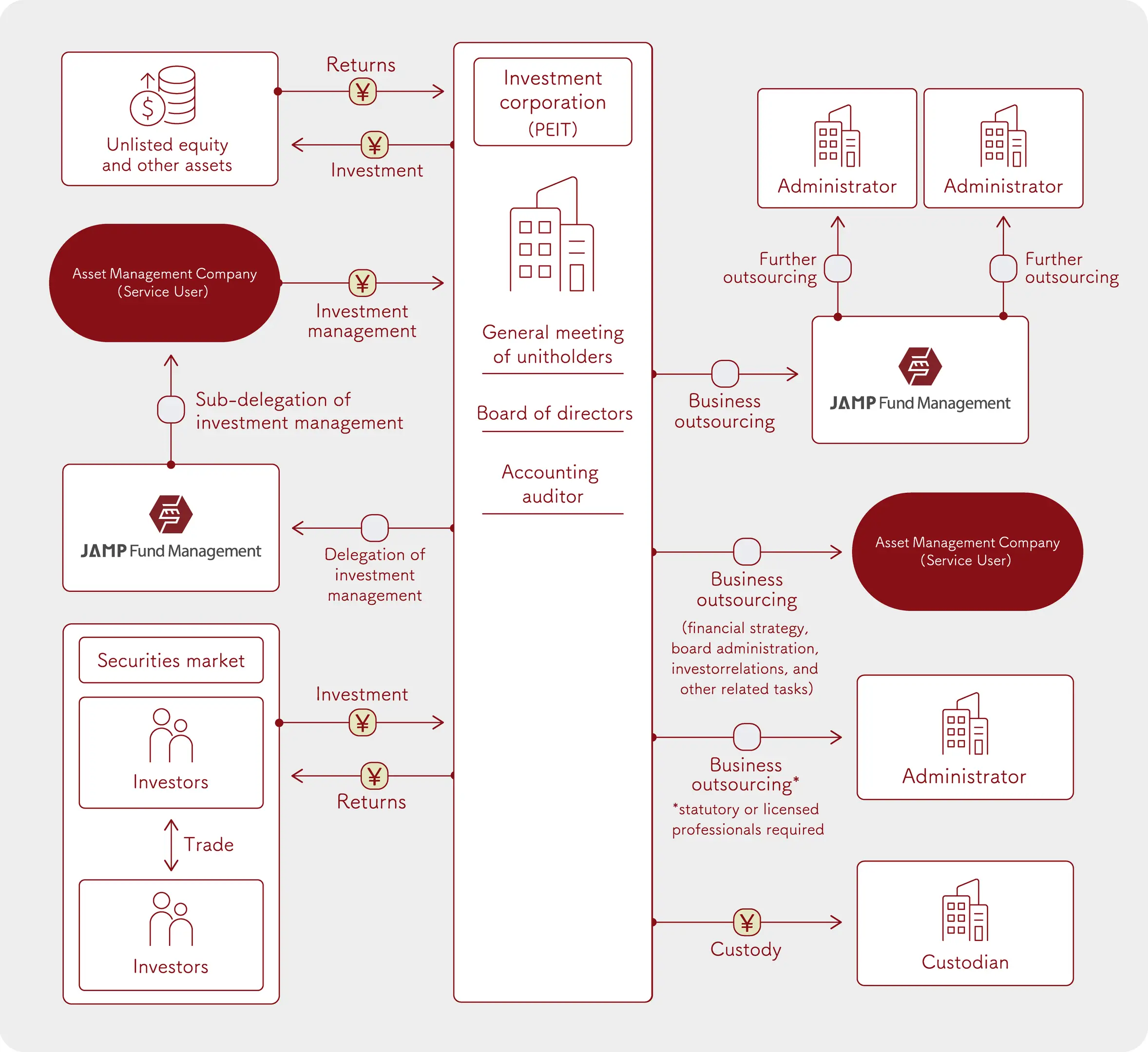 Overview of the PEIT operating platform envisioned by JAMP Corporation
The JAMP Group already has experience supporting this type of division of responsibilities. HiJoJo Global Unicorn Investment Corp., established in June 2026, uses JAMP Fund Management Co., Ltd.’s PEIT White-Label Services. JAMP Fund Management serves as the investment corporation’s asset management company and also supports its operations through administrative services and coordination with other parties, while HiJoJo Partners Inc. undertakes investment management functions under a sub-delegation arrangement, including investment sourcing and decision-making.
That experience can inform the development of regional PEITs, but it cannot simply be copied. Regional infrastructure and development projects require different investment expertise and different operating businesses at the investee level. If the JAMP Group provides a common platform for a regional PEIT, it will still be necessary to establish an investment management structure suited to the relevant assets and for the responsible asset management company to fulfill its own obligations, including oversight of any sub-delegated investment manager.
From a First Regional PEIT to a Repeatable Business
When developing the first regional PEIT, I want to examine not only whether the terms are acceptable to investors, but also whether each participant has a viable business role. That includes regional financial institutions responsible for project origination and continuing information provision, the asset management company, investment management sub-delegates, administrative service providers, and the provider of the common platform.
We need to identify which party is compensated for which function, clarify both initial and recurring costs, and test whether information updates and responses to problems will work in practice. If that experience allows more operating processes to be reused in subsequent regional PEITs and investment projects, the completion of one transaction can become the foundation for an ongoing business.
A regional PEIT is ultimately only one means of creating a “capital relay.” What I ultimately want to establish is a sustainable investment management model that connects regional companies and projects with the right providers of capital at each stage, while ensuring that assets are acquired and managed in the interests of investors. JAMP Corporation aims to support those structuring decisions and their implementation and, together with the relevant stakeholders, build the operating foundation needed to ensure that the capital relay does not end with a single transaction.
Author: Keiichi Ohara, President & CEO, JAMP Corporation
About This Article
This article is an adapted English edition of JAMP Perspective No.351, originally written in Japanese by Keiichi Ohara and distributed on September 23. It has been edited and supplemented where necessary to make the discussion and its Japan-specific context clearer to readers outside Japan. It is therefore not a direct translation of the original Japanese newsletter.
This article is provided for informational purposes only and does not constitute investment advice or a recommendation regarding any financial product.